
The passage of the political press as the press briefing was a little diary promoted by journalist Jaume Andreu and industrial dyers and Bartomeu Godo Carles Igualada Foot, the Liberal party service fusionist, THE FOREFRONT. Both were sons of Joan Pelegrí Godo, Igualada mayor and friend of Matthew Sagasta, and were also mayors and deputies to the Cortes. The first issue appeared on February 1, 1881 and seven days after Sagasta won the election. Then defined as "political ads Journal and News," was born as an organ of expression of a fraction of the Liberal Party of Barcelona, \u200b\u200bwhich aimed to get the mayor of the city.


Seven years later, began as a newspaper model independent, pluralistic and modern. December 31 ceased publication in 1887 as an organ of the Constitutional Party, and the January 1, 1888, the first day of the Expo of Barcelona, \u200b\u200bpresented a new format, with two morning and afternoon edition, and regardless of any political party . The journalist who managed to turn a party newspaper in the great reference of the independent press in Barcelona was Modesto Sanchez Ortiz, director between 1888 and 1901 to and integrated into the cultural life of Barcelona and opened the pages of young Catalan artists and intellectuals more stressed that they connect with the air renovators who lived in Catalan society. La Vanguardia also included the signing of intellectuals and of the leading writers of the "Generation of 98" .

On 25 October 1903, the newspaper moved from the streets of Les Heures , a modernist building number 28 on the street Pelai, while renewing its membership system. And under the direction of Miquel dels Sants Oliver, hired La Vanguardia the most prestigious partners Diario de Barcelona. One of his biggest successes was resonant and be the first English newspaper correspondents sent to Paris and Berlin, capital of the warring parties during World War. At that time, La Vanguardia fully linked with the Catalan cultural and social life, and became, with over 80,000 copies in the Journal of wider dissemination of Catalonia.

A Miquel dels Sants Oliver, who was director until 1920, succeeded the former Paris correspondent, Agustí Calvet "Gaziel." Under his leadership and entrepreneurial drive of Ramon Godo Lally, La Vanguardia established itself as the first newspaper in Spain and one of the largest in Europe. That success was possible because the paper was pioneer in introducing all the technical, the connection to the main agencies, the use of gravure in 1929, coinciding with World Expo , and the establishment of an extensive network foreign correspondents. Godo Ramon died in 1931, the that was succeeded by his son Carl.

The July 19 of 1936, Civil War broke out and the Government seized the day, which finished the stage direction Gaziel , who went into exile. During that period, La Vanguardia, subtitled "Diary in the service of democracy" was the main organ of expression, first by the Government of the Generalitat and later, the central government installed in Barcelona, \u200b\u200bthe Government of the Republic . illustrious intellectuals during the war stamped his signature on the paper. Due to the progressive restriction of paper copies whenever contained fewer pages and graphics notes were limited only to Thursdays and Sundays.

With the victory of Franco's side, the property regained financial control of the newspaper, but because of censorship, could not influence the editorial line. The newspaper was forced to change its historic head of the English La Vanguardia. Then imposed as director Luis de Galinsoga, whose leadership lasted until the very general Franco decided to relieve him from office in 1960 because of popular mobilization against it. During the 1940's, role constraints often forced to publish copies of four pages and up to a single sheet. In 1963, succeeded him in the direction of Javier Echarri, who remained in office until 1966. At this difficult stage of certain political transition, the new director, Horacio Sáenz Guerrero began an opening day directed towards plural and democratic, to represent the feelings of its readers. Then they began to collaborate in their prestigious pages reflecting the political spectrum most advanced of Catalan society. Since that time, the newspaper supported democratic change, the establishment of the monarchy and the restoration of the Generalitat de Catalunya. On August 16, 1978 regained the former name of La Vanguardia.

The newspaper held in 1981 its centenary with a profound technological change that prompted the new editor, Javier Godo , which entailed the incorporation of VDUs in drafting and other departments of the newspaper. On April 19, 1982 edition took out the Monday after the repeal of the Royal Order 1924 that forced the break Sunday newspaper publishers. On June 30, 1983, as director Lluís Foix, was published the last issue with typography made of lead. In October 1989, and directed by Juan Tapia, La Vanguardia presented a new design Manhattan designed by Milton Glaser which involved a further increase in quotas market in Catalonia and the rest of Spain. That change was completed with a new color Offset press.
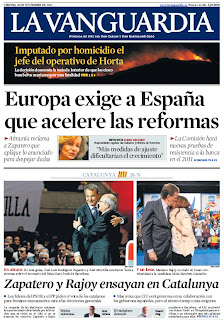

With the victory of Franco's side, the property regained financial control of the newspaper, but because of censorship, could not influence the editorial line. The newspaper was forced to change its historic head of the English La Vanguardia. Then imposed as director Luis de Galinsoga, whose leadership lasted until the very general Franco decided to relieve him from office in 1960 because of popular mobilization against it. During the 1940's, role constraints often forced to publish copies of four pages and up to a single sheet. In 1963, succeeded him in the direction of Javier Echarri, who remained in office until 1966. At this difficult stage of certain political transition, the new director, Horacio Sáenz Guerrero began an opening day directed towards plural and democratic, to represent the feelings of its readers. Then they began to collaborate in their prestigious pages reflecting the political spectrum most advanced of Catalan society. Since that time, the newspaper supported democratic change, the establishment of the monarchy and the restoration of the Generalitat de Catalunya. On August 16, 1978 regained the former name of La Vanguardia.

The newspaper held in 1981 its centenary with a profound technological change that prompted the new editor, Javier Godo , which entailed the incorporation of VDUs in drafting and other departments of the newspaper. On April 19, 1982 edition took out the Monday after the repeal of the Royal Order

In March 2000, José Antich happened to Juan Tapia in the newspaper's management, as part of a generational shift that coincided with the expansion of Grupo Godo. At the same time, Alfredo Abián replaced as deputy director Lluís Foix, who went on to play in La Vanguardia Digital responsibilities. Antich drafting restructured, renewed and expanded the network of opening new correspondent in Beijing, Buenos Aires or Havana, and introduced weekly topics of debate among specialists in various subjects. Sunday's daily supply increased with a charge of economy, a classified guide and a redesign of the Sunday magazine. In 2002 began to be published every Wednesday a new color insert called Culture / s. In April 2004, La Vanguardia
Source: Wikipedia.


